ROT: A Biopunk TTRPG
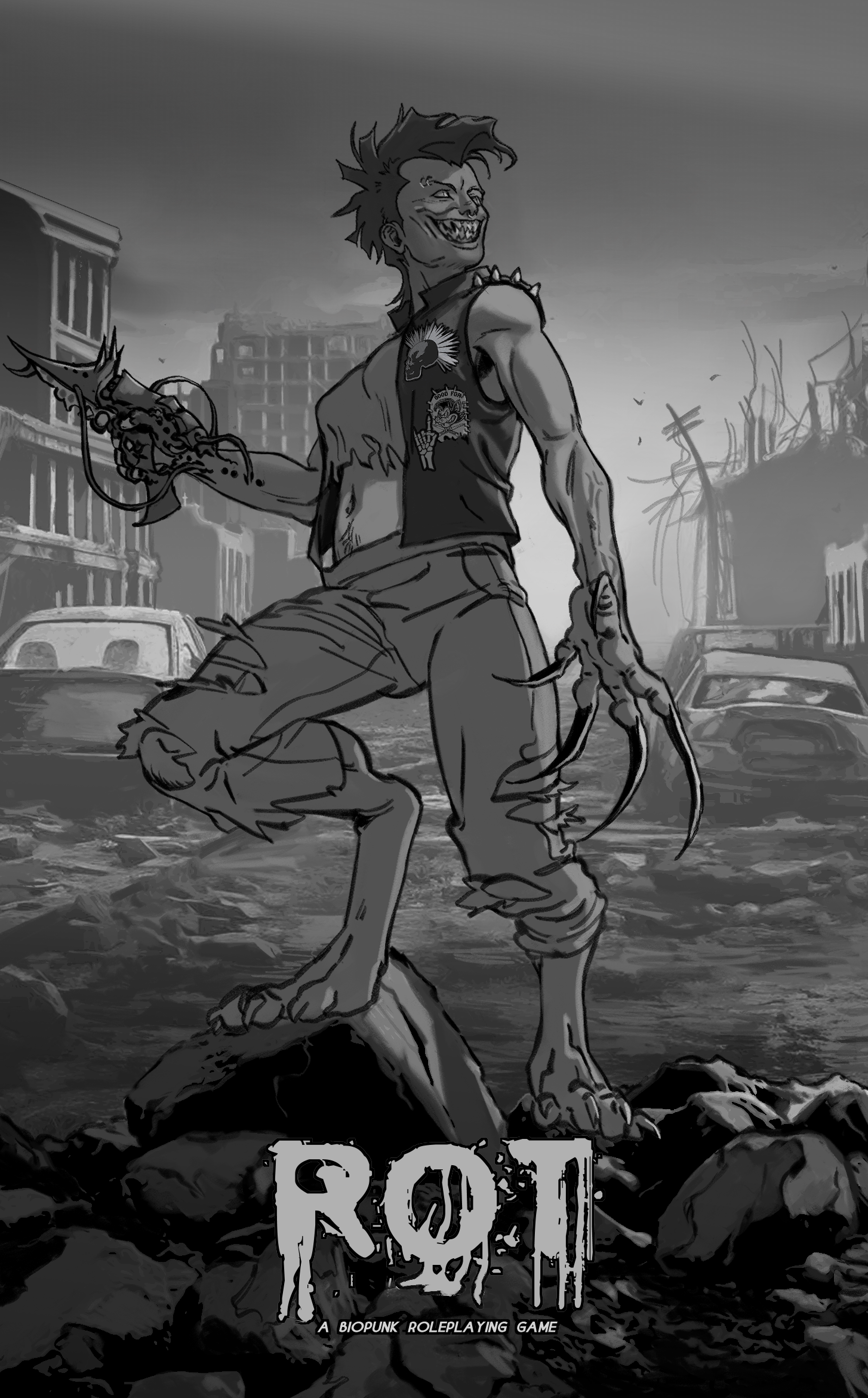
ROT is a unique tabletop role-playing experience that utilizes a standard deck of playing cards instead of dice. Dubbed the 52 system, ROT’s mechanical framework allows players to make tactical decisions based on the cards they’ve been dealt rather than just rolling a die. ROT is set in the far future in a land known only as The City, where an evil corporation controls nearly every aspect of people’s lives, including their ability to die. Players take on the role of mercenaries, fighting in the streets of The City to survive and ultimately rebel against the forces that seek to subjugate them.
Play The Game Here:
Feedback?
ROT is currently still in development, the core rules provided are a test version of what the final game will look like. If you have any feedback or suggestions after playing the game, please submit a form with the link below!
The Making of ROT
ROT was a personal project I developed to test alternatives to the standard d20 and d6s systems commonly used in TTRPGs. Prior to ROT I had been experimenting with a number of equipment-based progression systems, and knew I wanted to make a game where collecting items was the focus instead of traditional experience mechanics, but I wasn’t quite enjoying the randomness that dice lent to the design. So after some research and looking at games outside the genre, particularly video and casino games, I became obsessed with this concept of “controlled luck”. Basically, I wanted a game where luck was a factor, but the player had a greater influence over how that luck was applied. This naturally drew me to card games. With card games, what cards you have are completely determined by random chance; you have no control over how the cards are shuffled or which cards will appear in your hand. But which cards you play in the hand you’ve been dealt is something you have full control over. I wanted to create a TTRPG that took advantage of controlled luck to lend a greater sense of strategic depth to the game.
The Importance of Criticals
Cards as a mechanic were established pretty early on, but with that idea came a big problem. Typically, the way skill checks in TTRPGS function is the game master sets a number based on the difficulty of the action, and players try to roll a number that exceeds the value chosen on one or more dice. To keep the game simple and approachable to returning TTRPG players, I sought to maintain that process. But while testing using cards instead of dice players would approach all checks by simply playing their highest cards. Face cards make up 12 of 52 slots in a deck of cards, and with the game being Aces high, that means that there’s a 16/52 (roughly 30%) chance that a card drawn will be very good. Multiply that by 7, and odds are in a game where the goal is simply to play high cards players will come out on top a majority of the time. So I couldn’t just fall back on standard practice when designing skill checks for the game. At first, I tried making the metric for success more random. When a check was warranted, the gm would draw a card from the deck, and players would have to play a card with a value within a certain range of what was drawn. This quickly became too confusing for testers and was scrapped. But the idea of encouraging players to use cards within a certain value was still interesting, so I leaned into it while maintaining the old “play over” style of skill checks. What I ultimately settled on was changing the way critical successes worked in ROT. The way ROT’s skill checks work now is a hybrid of the two concepts that were tested. To make a skill check in ROT, the GM selects a Test Number, or TN, that players must exceed to succeed in their action. But, if they are able to play a card whose value meets the TN exactly, they will receive a critical success, providing them with crucial boons. Equipment in ROT comes with a number of unique abilities, providing valuable support in and out of combat, but those abilities only apply when a critical success is achieved. In this way, the metric for success changes. If a player wants an attack to hit they can just play a high card and it is likely that attack will succeed, but if that player wants to use the super cool acid effect their gun has? They have to be more tactical with the cards they use. Suddenly, rather than just throwing out cards without thought, testers started to think far more carefully about when to use those high cards and when to hold them, creating a new depth the game had previously lacked. Critical successes make ROT fun, and their implementation has been prioritized throughout the game.
The Limb System
I have always been a big fan of body horror. My favorite horror movie is The Thing, I took a class on Cronenberg in college, and I consistently enjoy games that play with the human form in all manner of nasty ways. So early on in the development process, I knew that I wanted to include aspects of body horror in my design. This gave rise to the Limb System, the mechanic that ties all of ROT together. Rather than progressing through experience or milestones, players grow stronger by grafting unique limbs onto their bodies that give them unique abilities. These limbs twist and deform the player characters in grotesque ways, but give them many different approaches to all manner of scenarios. Need to cross a gap? You can have wings. Need to break out of jail? Chew through those prison bars with an iron jaw and an enhanced digestive system. Need to smash someone’s face in? Bone club. Now, having crazy body horror limbs in the ROT is all well and good, but I wanted a way to differentiate them mechanically from other games. A bone sword growing from your arm sounds really cool, but if it functions exactly like other weapons in other systems, it may as well just be a sword! So to spice up ROT I decided to lean further into body horror by changing how damage works in the game. Normally in other systems player characters have one health bar. That bar hits zero and the character is incapacitated or dead, it’s very simple and easy to understand. ROT on the other hand, has multiple health bars for each limb characters have equipped. Rather than just attacking an enemy, players choose which limbs on that foe to target, with the goal of ultimately disabling those parts and making them unable to fight back. Legs can be destroyed to stop an enemy from moving, arms can be taken out to disarm them, and heads can be severed to end the fight entirely. In this way, players are encouraged to be more surgical with their opponents’ bodies, carefully deciding which limbs to destroy and which to avoid entirely. The limb system, as it is implemented now, accentuates the body horror of the game by turning players into butchers, and their enemies into meat.